

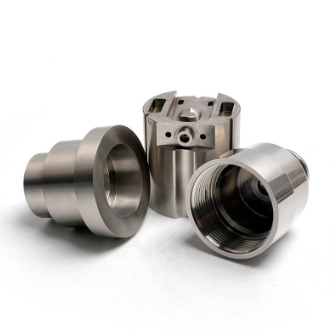
Thin walls are attractive because they reduce weight and create compact housings, but they also remove the very stiffness that helps a part resist cutting forces. During CNC milling, a slender wall can vibrate, spring away from the tool, or distort after surrounding material is removed. CSMolding’s published milling guidelines identify minimum wall-thickness considerations and note that plastics generally need more thickness than metals, a useful reminder that stability depends on both geometry and material.
Stiffness changes as machining progresses
A wall that looks strong in the finished CAD model may be unsupported midway through manufacturing. The machining sequence matters: leaving reinforcing stock in place temporarily can help, but the final passes still occur on a flexible feature. Long, tall walls are especially sensitive because their unsupported length magnifies deflection.
Where function allows, add ribs, shorten free spans, or thicken the base of a wall. Smooth transitions also distribute load better than abrupt changes. If an enclosure must have a thin exterior, internal geometry may provide stiffness without changing the visible silhouette.
Metal and plastic behave differently
Aluminum walls can often be machined relatively thin with careful strategy, whereas plastics may react more strongly to heat, clamping pressure, and residual stress. A polymer component that is dimensionally correct while clamped can relax after release. Stainless steel or titanium presents a different challenge: higher cutting forces and heat can make a fragile geometry difficult for other reasons.
This is why a single universal minimum is risky. Use published guidelines as a starting point, then discuss unusually thin or tall features with the manufacturer.
Tolerance should follow functional need
Requiring an extremely tight thickness on a flexible wall can multiply the difficulty. Ask whether the wall controls a fit, an optical path, a sealing interface, or simply provides a cover. If only local regions matter, dimension those features rather than applying severe tolerance to the entire surface.
For prototypes, the physical part can also teach the design team where stiffness is insufficient. Test assembly loads and fastening torque, not just free-state dimensions. A wall that passes inspection but bows when a screw is tightened is still a design problem.
Successful thin-wall design balances mass and rigidity with an honest view of manufacturing forces. Give the cutter access, give the part enough support, and reserve the thinnest sections for places where product performance actually benefits.
